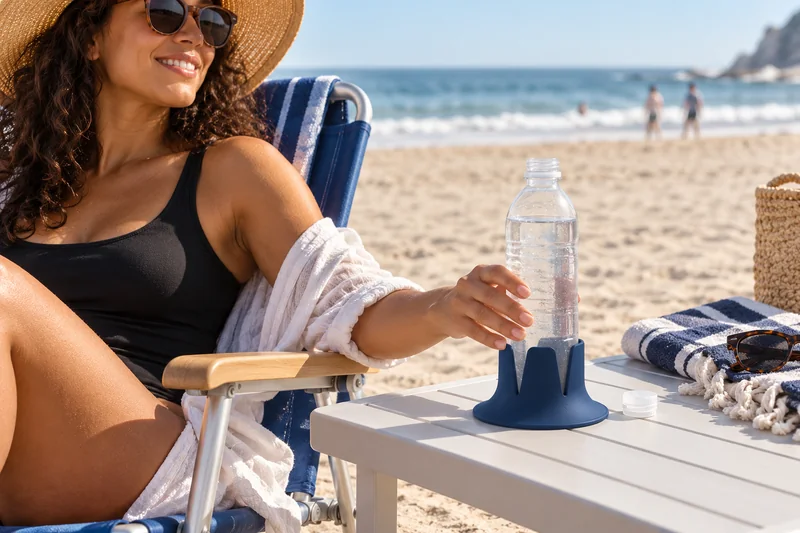
The Last Notch: Why the Drinking Stops Once the Beach Chair Goes Flat
Reclined flat in a low beach chair, sipping quietly stops. The reach geometry, the swallow, and exactly where a drink has to sit to get drunk.
Nobody decides to stop drinking at the beach. You just look down around four o'clock and the cup is still three-quarters full, the ice is gone, and you have somehow been mildly thirsty for two hours in a chair you specifically bought so you would not have to get up.
What happened is not laziness and it is not the heat. It is that somewhere around the fourth notch of the recline, a sip stopped being one small movement and became a small project — and your body quietly ran the math and decided the project wasn't worth it. Every time.
This is the part of the beach chair problem that no product page addresses, because it isn't about the drink tipping over. It's about the drink never getting picked up in the first place.
Sitting upright at a table, a sip is basically one motion. Reclined in a low chair on sand, the same sip is a sequence, and each step has its own price:
Almost every piece of beach gear ever sold addresses step 2. Cup holders, stakes, side tables, clip-on trays — they all move the drink closer. But the steps that actually make you quit are 1, 5 and 6, and those are still exactly as expensive as they were before you bought anything.
Here is the part that surprised me, and it explains the specific moment the drinking stops rather than just "reclining is awkward."
Researchers using high-resolution manometry measured what a swallow actually costs at different body angles. Ten healthy adults swallowed water on a table that tilted them from upright all the way through to fully inverted, with pressure sensors reading what the throat actually did at each angle. (Rosen et al., Dysphagia, 2018)
At a 45-degree recline, the swallow was statistically indistinguishable from sitting bolt upright — about 130 mmHg of palatal pressure versus 125 upright.
At 90 degrees — flat on your back — the pressure jumped to about 146 mmHg, and it kept climbing past that. Lying back, your throat has to push harder to move the same mouthful of water, because gravity is no longer helping it along.
Two honest caveats: that's ten healthy people swallowing 5 mL of water in a lab, and the finding is about effort, not danger — a healthy body compensates without you ever noticing it happened. But it lines up exactly with what your beach day feels like. Halfway back, drinking is fine. At the last notch, something is subtly harder, so you lift your head to make it easy again — and that head-lift is the moment your brain starts pricing sips.
It is also why speech-language pathologists teach patients how to sit and how to angle the head when swallowing is difficult. Posture is not a comfort preference in this system; it's part of the mechanism. (Cleveland Clinic)
Which gives you a clean dividing line for a beach chair:
Worth saying plainly: the reclined chair is not the villain. OSHA lists reclined sitting — torso straight, leaned back 105 to 120 degrees from the thighs — as one of its recognized neutral working postures, the kind that reduces strain rather than causing it. (OSHA Computer Workstations eTool) A beach chair simply reclines well past the range office ergonomics ever bothered to think about, and takes your drink into unmapped territory with it.
Ask people why they stop drinking reclined and they'll say "reaching is annoying." Watch them and it's the opposite. Reaching down is easy. Putting it back is what makes you sit up.
Retrieval is forgiving — your hand closes on a cold can from any angle. Replacement is not. To set a can back into sand you have to find the socket, get the base square over it, press, and confirm it stayed. You cannot do that with your eyes closed, so you look. Looking means lifting your head. Lifting your head means you're basically sitting up. And because a socket in dry sand re-shapes every single time, you get to do the whole thing again on the next sip.
This is also the reason people who already own the screw-in sand spike still stop drinking. The stake solves standing-up-straight; it does not solve blind return, because it's a tight ring at ankle level that you have to aim at. Tight fit plus poor aim is how the whole stake comes out of the sand with the drink still in it.
For a target to be hittable without looking, it has to be three things: fixed between sips, wider than the container, and forgiving of a sloppy approach. Loose sand is none of the three. It is a target you have to rebuild every time you use it.
Four coordinates. None of them is where people actually put their drink.
Height: the beach chair is the one scene where the ground is the correct shelf.
This is the genuinely counterintuitive part. Ostrich publishes 12 inches off the ground for its classic low beach chair. (Ostrich 3N1) At that seat height, with your arm hanging off the armrest, your knuckles are only a few inches above the sand.
Now do the arithmetic on what's in the cooler. A standard 12 oz can is 4.83 inches tall. (Drink can dimensions) A 40 oz Stanley Quencher is 11.02 inches, with the straw above that. (Stanley 1913) Standing on the sand beside a low chair, the can's lip is right about at your dangling fingertips, and the tumbler's straw is up around armrest height.
In other words: the ground beside a low beach chair is already at drink height. Nothing needs to be raised. In a camp chair, a stadium seat, or a folding chair on a patio, the ground is far below your hand and you genuinely need a table or a mount. On sand, in a low chair, you don't need furniture — you need the ground to hold still and stay where you left it.
Front-to-back: the hip line, not the knee line.
Everybody sets their drink down while sitting upright, which means they put it near the front chair leg, out by the knee, where they're looking. Then they recline. As the back drops, your shoulder rotates back and down about the seat, and the arc your hanging arm can sweep goes back with it. The spot you chose while upright is now ahead of your reach, which is why the first sip after reclining is the one that requires a full sit-up. Set the drink level with your hip — or slightly behind it — before you go back.
Side: outboard.
The cooler goes between the chairs, so the inboard side is the traffic lane: knees, kids, someone kneeling to dig for a popsicle. Put the drink on your outside hip. Same reach, none of the traffic.
Distance: a hand-drop, not an arm-stretch.
Run this once, on your own chair, and you'll never guess again. Recline to the notch you actually use. Close your eyes. Let your arm fall off the armrest naturally, the way it does when you're reading. Note where your knuckles land on the sand.
That patch — about the size of a dinner plate — is the entire target. Anything inside it gets sipped all afternoon. Anything outside it gets exactly one sit-up, and then gets relocated to the cooler lid and forgotten.
Once you're flat, the head-lift is fixed cost. Everything else is negotiable, and the container decides how much else there is.
| Container | Standing on sand, its drinking end is | What one sip costs at the flat notch |
|---|---|---|
| 40 oz tumbler with straw lid | up around armrest height | head-lift only — the cup never leaves the ground |
| Insulated bottle with a straw lid | roughly hand height | head-lift only |
| Standard 12 oz can | at your dangling fingertips | grip, lift, head-lift, blind return |
| Slim seltzer can | fingertip height, narrow and open | same, plus it's the least stable thing in camp |
| Fountain cup with a straw | wide top, flimsy walls | head-lift only — if it's still standing |
| Water bottle, capped | fingertip height | grip, uncap, lift, head-lift, recap, return |
This is the honest reason the 40 oz Quencher took over the beach and the slim seltzer can never will. A straw deletes steps 3, 4 and 6 in one move: suction brings the liquid up, so the container never has to leave the ground, never has to be aimed at your mouth, and never has to be put back. Stanley designed that tumbler's tapered 3.1-inch base to drop into a car cup holder — and accidentally built the best reclined-beach-chair container on the market, provided it's standing on something that will keep it upright.
Your chair has a cup holder. It is not in the dinner-plate circle, and here's the specific reason, said plainly.
Beach chair beverage holders live up at seat level, in a side pocket or a mesh sling — GCI's SideKick, for example, has a 3-position backrest that lets you sit up, lean back or stretch out flat, and combines its beverage holder with a phone pocket in the side of the chair. (GCI Outdoor) That's a fine place for your elbow. It is not where your hand falls. To use it you have to flex up and in against the side of the chair instead of letting your arm drop, which is a small tax you notice about the fourth time.
Then there's size. GCI publishes no diameter for either holder — not for the SideKick's pocket, not for the mesh sling on its 4-position Backpack Beach Chair. (GCI Outdoor) What can be measured is what goes into them: a standard 12 oz can is 2.6 inches across at the widest point of its body. (Drink can dimensions) The tumbler this crowd actually carries has a 3.1-inch base and stands eleven inches tall — a container Stanley built to the car cup holder standard. So the tumbler goes in the sand, and the holder holds a phone.
And on sand, a fourth failure the specs never mention: the whole holder tilts whenever one chair leg sinks further than the other three.
None of which makes it useless. When your container fits and the chair is sitting level, the armrest holder is genuinely the best spot on the beach — you should use it. It just wasn't designed for the drink you're actually carrying, on the surface you're actually on, at the angle you're actually lying at.
Everything above adds up to one requirement: a fixed, forgiving target sitting on the sand exactly where your hand already falls. Not higher. Not attached to anything. Just a spot that is the same spot on the next sip as it was on the last one.
That is the specific job the Steadi base is built to do. It's one piece of Shore 85A TPU — never silicone — 2.8 inches tall, with a base 5.2 inches across that is fixed and does not expand, contract or deform. The fins flex to grip the container's bottom inch. Because that base is wide and rigid, the container's centre of mass has to travel much further sideways before it passes outside the base, so it takes a far bigger tilt to knock over: it resists tipping, and the tack of the TPU resists sliding on a slick cooler lid. It sits on the ground, which — on a low chair — is where your hand already is.
Now the parts you should know before you decide anything.
It does not attach to your chair. It is not a mount, a clamp, a strap or a restraint, and it does nothing at all for the sagging mesh holder that annoyed you into reading this. If what you want is a fix for the armrest, this is not that, and it would be dishonest to pretend otherwise. What it is: a wide, rigid target you set on the ground, inside the arc your reclined arm already sweeps.
Fit is the thing to settle before you order, not after. The opening takes a range of container bases, and that range is the one number this article will not print for you — measure the base of the container you actually carry and check it against the current fit page at steadilabs.com.
Handled mugs are an honest no — the handle blocks a fin. It doesn't float; it sinks, so it stays above the waterline with the chairs. It doesn't insulate and it doesn't seal. And a direct hard knock — a running kid, a thrown football — still wins. It also doesn't change the surface underneath it: set on loose sand, it is only as level as the patch you set it on.
It's dishwasher safe, molded in Orange, California, patent pending. Ninety days from delivery to send it back, free returns, and used-and-sandy is fine. Checkout happens at steadilabs.com.
Not a gadget. Not a system. Just this: at four o'clock, the cup is empty because you drank it — and you never once sat up.
You'll check out on steadilabs.com, the maker's own site.